


Ningbo University 40th Anniversary and 30th Anniversary of the Merger of the Three Universities Anniversary Academic Activities: Fenghua Young Scholars Forum
 Sep 18, 2026


Published: September 18, 2026
Posted by: Ye Changsheng
Reviewed by: Yu Lichuan, Yin Jun
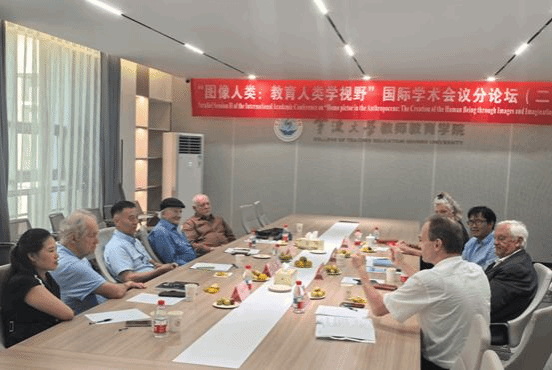
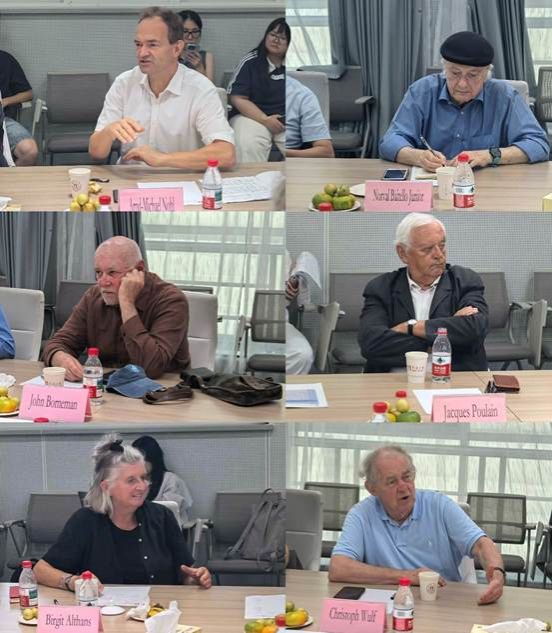
On the afternoon of September 16, 2026, our School held the Fenghua Young Scholars Forum in Meeting Room 413 of the Education Building. Professor Christoph Wulf from the Free University of Berlin, Germany; Professor Birgit Althans from the Kunstakademie Düsseldorf, Germany; Professor Arnd-Michael Nohl from Helmut Schmidt University, Hamburg, Germany; Professor John Borneman from Princeton University, USA; Professor Jacques Poulain from the University of Paris VIII, France; and Professor Norval Baitello Junior from the Pontifical Catholic University of São Paulo, Brazil, among others, were specially invited to conduct discussions. The forum was chaired by Professor Chen Hongjie, and relevant faculty and students from the School attended.

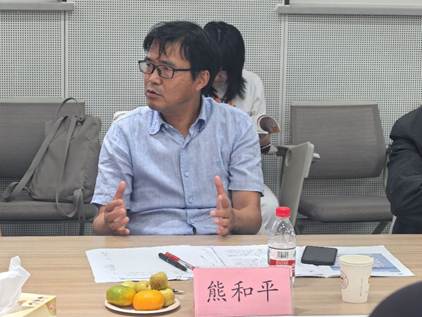
At the beginning of the meeting, Professor Xiong Heping and the foreign experts reviewed the historical evolution of educational images. From the time of Comenius, who first advocated that children need pictures, to today’s society overflowing with images, education is facing a fundamental shift from “a lack of images” to “an excess of images.” Participating experts pointed out that modern children are in a torrent of images, where one image rapidly replaces another, making it difficult for them to form a deep perception of images. Therefore, education urgently needs to guide children to develop a conscious image awareness and learn to examine the meaning of images and their impact on life.
Several scholars focused on the acceleration phenomenon and “chronocracy” in contemporary society. Digital devices enable images to spread globally at extremely high speed. This acceleration not only compresses people’s time for experience but also strengthens power control through the organization of time. The premature intervention of technology, especially artificial intelligence, is replacing other forms of human experience for children and affecting their long developmental process. Scholars emphasized that we cannot simply regard technology as a natural extension of human beings, but should be alert to its potential deprivation of children’s perception and creativity.
In response to the drawbacks of visual centrism in the image age, the conference explored in depth the educational value of the body and touch. Through cases such as soldiers’ field training and children’s natural experiences, scholars pointed out that real physical contact and immersion in nature can help young people break free from objectifying control over the world and rebuild their connection with the world. However, due to factors such as safety anxiety, modern society often replaces real touch with digital images, even leading young children to develop an “electronic snack”-style dependence on digital devices. The conference called on education to value touch, boredom, and meditation, and to provide children with opportunities to truly experience nature and interpersonal interaction.
From the perspectives of new materialism and material feminism, scholars analyzed how objects, bodies, and spaces in the classroom participate in the educational process. Through specific classroom observation cases, they revealed how objects such as teachers’ chairs and teaching aids convey hidden power relations. The research emphasized that students’ interaction with the material world is a dimension that cannot be ignored in education and should be incorporated into the vision of educational research.
Finally, in his summary, Professor Chen Hongjie stated that the Chinese theme of this conference was “Educational Images and Educational Anthropology,” while the English theme focused on “Humans creating through images and imagination.” The two are complementary and jointly point to a broad understanding of education. The conference not only deepened dialogue between Chinese and foreign scholars in fields such as image theory and educational philosophy, but also laid a solid foundation for future cooperation.
【Close 】


